
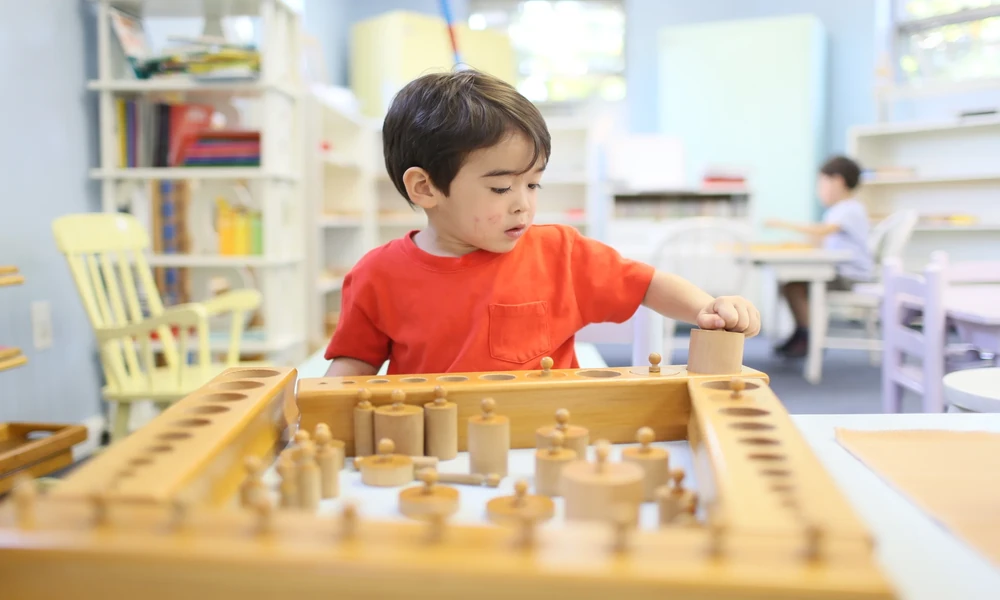
What is the right age for nursery school? In Hyderabad, many programmes begin around age three, while some accept children slightly earlier. Eligibility depends on each school’s programme, date-of-birth cut-off and current policy. Parents should consider both the published entry criteria and whether the environment suits their child.
The answer has three parts: the calendar, the child and the teacher.
The calendar: what is the right age for nursery school under the rules?
India’s National Education Policy describes ages three to eight as a foundational stage, encompassing preschool and the first two years of primary school. That framework is useful context, but specific nursery and Class 1 eligibility dates can vary by institution, board and academic year.
Before relying on a single age rule, ask the school for its current written criteria, including the date-of-birth cut-off and how its nursery years connect to Class 1.
This explains why families may receive different answers when comparing schools. Confirm the nursery admission age directly with each institution rather than assuming the same policy applies everywhere in Hyderabad.
The child: what readiness looks like at home
A birthday makes a child eligible. It does not show whether a particular morning in a particular room will suit them. Readiness is better seen in ordinary moments at home, and none of what follows is a developmental milestone or a medical test. A child does not need every sign, and missing one is not a reason to delay professional advice if a family has a concern.
The first sign is trust in someone other than a parent. A child who can spend part of a morning happily with a grandparent, relative or regular caregiver already knows that other adults can be relied on. Tears at parting are normal and do not, on their own, signal unreadiness.
The second is a way of being able to communicate their needs. Fluent English is not required. Pointing, gesturing, or speaking Telugu, Hindi, Urdu or any home language all count, provided the child can somehow say ‘I’m hungry’, ‘I need the toilet’ or ‘I don’t like that’.
The third is the wish to do things by themselves. ‘Me do it!’ is one of the clearest readiness signals there is. A child who insists on carrying their own bag or pouring their own water will usually enjoy a room built for independence.
The fourth is a familiar daily routine. When a child’s day at home follows a particular order, with meals, play and rest coming in roughly the same sequence, the child builds an internal sense of order, and with it a feeling of safety and security. A child who knows what usually comes next carries that security into a new setting, so a nursery morning feels familiar rather than chaotic.
The fifth is curiosity about other children. This can look like observing from a distance, playing alongside another child without interacting, or imitating an older child. Shared, cooperative play develops gradually and does not need to be in place before nursery begins.
What readiness is not
Several things that worry parents are not needed for nursery at all. A child does not need to know the alphabet, count to twenty, write their name or sit still for long periods. Children of this age learn best through play and activity, which is what India’s national guidelines for early education now expect, and good nurseries build these skills after entry, not before it.
Some concerns belong elsewhere. Questions about a child’s hearing, speech, movement or development are best taken to a paediatrician, without waiting for a school to raise them. A nursery admission is not the place for a diagnosis.
The teacher: five questions, rewritten
Parents often arrive at nursery parent sessions and admission meetings with questions that invite reassurance rather than information. Each of the following can be sharpened.
Instead of ‘Is my child ready for nursery?’ ask ‘How do you help a child who finds saying goodbye hard, and can a parent stay at first?’
Instead of ‘Do you teach in English?’ ask ‘How will your adults understand my child if they speak mostly in our home language?’
Instead of ‘What will my child learn this year?’ ask ‘What will my child be able to do for themselves in your classroom?’
Instead of ‘What are your timings?’ ask ‘Can you walk me through a typical morning, from arrival to going home?’
Instead of ‘Will my child make friends?’ ask ‘What do you do when a child prefers to observe rather than join in?’
Each rewritten question maps onto one of the readiness signals above, which makes a teacher’s answer easy to compare with what a parent already sees at home.
How to prepare for nursery admissions
Preparation matters more than paperwork. For parents, that means seeing how each school works: many nurseries keep visitors out of classrooms while children work, and show parents the environment through a parent session, open day or orientation workshop instead. Attending these at two or three schools, with the rewritten questions in writing, keeps the comparison fair, and asking each school to describe its process from first enquiry to the first day avoids surprises.
For the child, a first visit or observation goes best when it feels ordinary: tell them simply where they are going, make sure they are rested and fed, and let them explore at their own pace rather than coaching them to perform.
At home, short and predictable separations with another trusted adult do more good than long explanations about school, and toddlers tend to take their cue from the tone in which school is discussed.
Nursery admissions in Gachibowli and Tellapur
In West Hyderabad, Blue Blocks Montessori School runs its pre-primary years at both its Gachibowli campus, opposite DLF Gachibowli, and its Tellapur campus. The school admits children from 2.5 to 6 years. The Montessori primary years serve children from three to six, and joining at two and a half gives a child time to settle before they begin, so that they experience the full three-year cycle from youngest to oldest.
For parents researching “nursery admission age in hyderabad“, the Blue Blocks nursery programme provides an overview of the learning environment, although current entry criteria should be confirmed directly with the school. Families asking “how to prepare for nursery admissions” can review the admissions process and enquire about any observation, visit or documentation requirements.
Frequently asked questions
Does my child need to know letters and numbers before nursery admission?
Usually, readiness is broader than recognising letters or counting on command. Communication, curiosity, ability to seek help and comfort with a new routine may be more useful topics for a parent-school conversation. Each institution sets its own entry process, so confirm its current criteria rather than assuming there is a universal academic test.
Is toilet training compulsory for nursery admission?Policies vary by school and programme. Ask about access to bathrooms, support with changing clothes, how accidents are handled and how staff communicate with parents. Many schools expect children to use the toilet independently when they join nursery, so it helps to start toilet learning early at home and to talk openly with the school about your child’s progress.What if my child is shy or cries during the first week?
An unfamiliar environment can feel difficult even for a child who is ready to learn. Ask how teachers build trust, whether arrival routines are consistent and how parents receive updates. A sensible approach reviews the child’s experience over several visits instead of deciding based on the first morning alone.
Which admission details should Hyderabad parents confirm in writing?
Before applying, request the current date-of-birth cut-off, programme eligibility, campus availability, school-day timings, fees, documents and any orientation requirements. These details may differ between institutions or admission cycles. Written confirmation prevents parents from relying on an outdated blog post or a general citywide age assumption.